You’ve spent years building your content empire. Late nights perfecting blog posts. Countless hours researching keywords. Maybe you’ve even celebrated watching your organic traffic climb month after month.
Then suddenly, the numbers start dropping. But here’s the maddening part your rankings haven’t changed. You’re still on page one, sometimes even position one. Yet the visitors? They’ve vanished.
This isn’t your typical algorithm update. This is Google fundamentally rewriting the rules of how people find information online. And if you’re feeling that knot in your stomach, you’re not alone.
Google’s “Show More” Button No Longer Means More Clicks
Remember when clicking “Show more” felt like opening a treasure chest of discoveries? That innocent little button used to promise deeper exploration, more perspectives, a journey across the web. Now? It’s becoming a trap door that keeps users locked inside Google’s world.
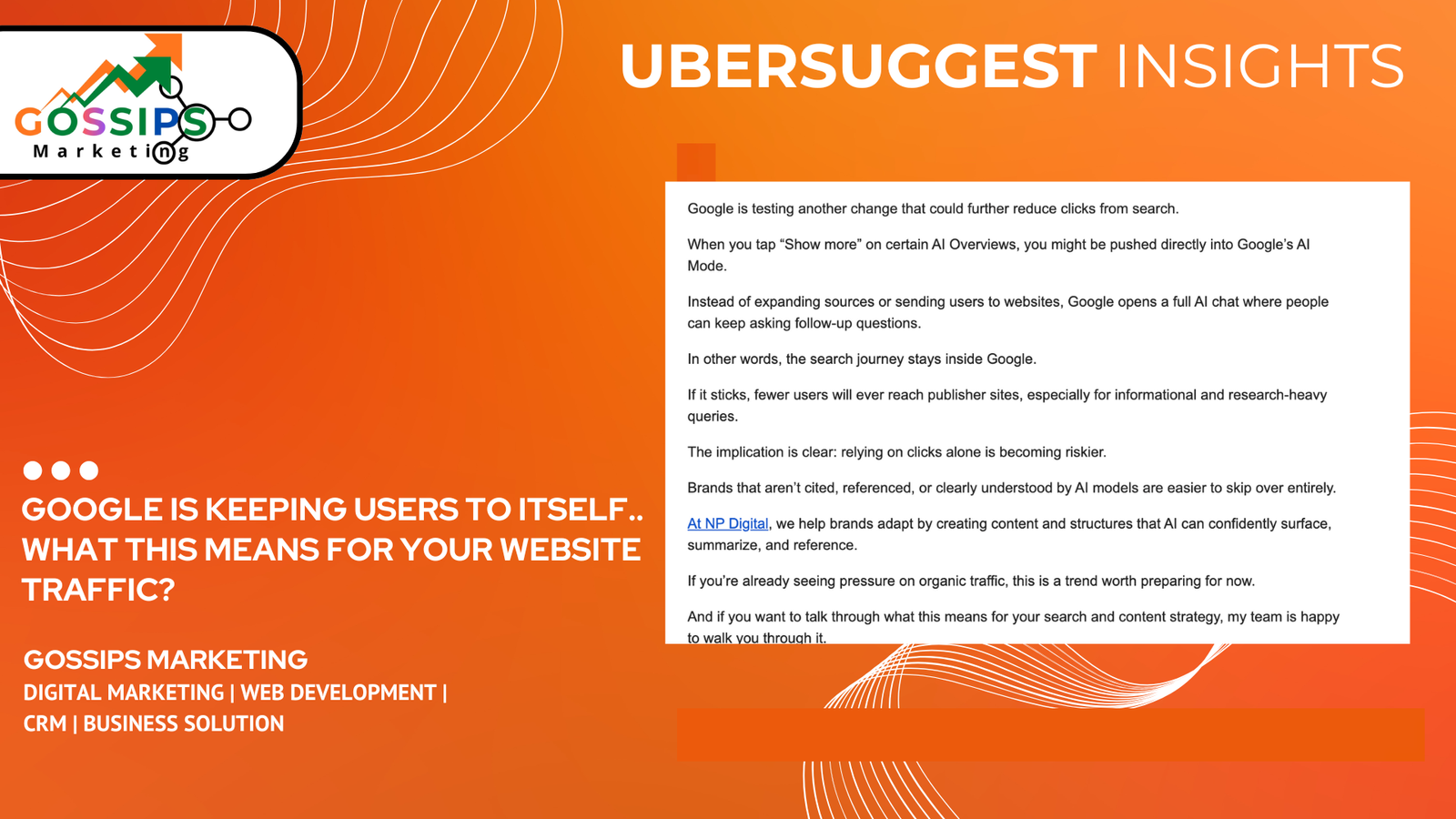
Here’s what’s actually happening: When someone clicks “Show more” on an AI Overview, they’re not seeing more search results anymore. They’re entering a full-blown AI chat conversation. Google basically installed a velvet rope at the entrance to your website—and they’re telling visitors they can get everything they need without ever crossing it.
The statistics feel personal because they are. That 13% decline in clicks? That’s real people who would have visited your site last year but now get their answers from an AI summary. The 60% traffic drop publishers are reporting? Those are actual readers, real potential customers, gone.
How Google’s AI Mode Is Changing the Search Journey
Picture this: Sarah needs to understand content marketing funnels for her new business. Two years ago, she would have searched “how to build a content marketing funnel,” clicked through three or four articles, maybe signed up for a newsletter or two. She’d have discovered your blog, your expertise, your brand.
Today? She searches the same phrase, gets an AI Overview that explains the basics, asks the AI follow-up questions like “What are the pros and cons?” and “Can you give me examples?” The AI obliges, pulling from who-knows-where. Sarah gets her answers. Google keeps her attention. And you? You never even entered the story.
This is AI Mode the conversational search experience that’s replacing exploration with instant gratification. Users aren’t just accepting AI answers; they’re preferring them. When an AI Overview appears, 68.8% of searches end without a single click. No exploration. No discovery. No you.
Why Organic Traffic Is Under Serious Pressure (And Why It Hurts)
Let’s be honest about what those traffic numbers really represent. That visitor who didn’t come to your site today? They might have become your next client. That reader who got their answer from AI instead? They might have shared your article, joined your community, bought your course.
The pressure isn’t just statistical it’s existential. B2B companies watching 25-35% of their organic traffic evaporate aren’t just seeing numbers drop; they’re seeing pipelines dry up. News publishers with 77% zero-click rates aren’t just losing pageviews; they’re losing the connection to their audience.
One content creator on Reddit captured the desperation perfectly: “My rankings have improved, but I’ve lost a third of my traffic. It feels like I’m shouting into a void.” That void? It’s Google’s AI, answering questions with your competitors’ content, or worse, generic information that doesn’t carry your unique voice.
The cruelest part? You’re doing everything right. Your technical SEO is solid. Your content is comprehensive. Your keywords are perfectly targeted. And it might not be enough.
The Rise of Zero-Click Search in the AI Era
Zero-click search has been creeping up on us for years. Featured snippets started it why click when the answer’s right there? Knowledge panels continued it why visit your About page when Google shows your info?
AI Overviews just scaled it to everything. That complex, nuanced article you spent weeks researching? Google can now summarize it in three bullet points. That in-depth guide you wrote? The AI can extract the key steps and present them as a complete answer.
Similarweb’s data tells a sobering story: searches with AI Overviews result in no clicks 68.8% of the time, compared to 54.9% for searches overall. For some publishers, it’s worse 71.2% of their search traffic never leaves Google.
We’re caught in a vicious cycle. As AI answers get better, users click less. As users click less, we get less data about what they need. As we understand less, AI becomes the primary source. The web risks becoming a content farm for AI training rather than a place where humans connect with humans through words and ideas.
Why Being Ranked Is No Longer Enough
Here’s a truth that stings: Being #1 on Google used to mean winning. Now it might just mean you’re the closest runner-up to an AI that took the gold medal.
The problem isn’t your ranking it’s your recognizability. AI models don’t care about your keyword density or backlink profile the way traditional algorithms did. They care about whether you’re an entity they understand and trust. They care about whether your brand name appears in authoritative sources. They care about whether you’re mentioned in contexts that signal expertise.
Companies like HubSpot and Salesforce still get cited in AI answers even when users never click through. Why? They’ve become entities. They’ve built authority that transcends individual pages. They exist in the AI’s understanding of the world.
For the rest of us, this means a new game with new rules. If AI models don’t recognize you as a trusted source, you risk being completely invisible even when you’re technically “ranking.”
From Clicks to Citations: The New Visibility Metric
Success in search is quietly shifting from “How many people clicked?” to “How often does AI mention us?” It’s a mental shift that feels wrong because it is. We built our businesses on traffic. We optimized for clicks. Now we’re supposed to care about citations?
Yes. Because citations are the new impressions. When AI accurately summarizes your content, even without a click, it’s building brand awareness. It’s establishing your authority. It’s creating a connection that might lead to a direct visit later.
This is Generative Engine Optimization (GEO), and it’s different from SEO:
- SEO was about being found. GEO is about being understood.
- SEO chased keywords. GEO builds authority.
- SEO measured clicks. GEO measures citations.
The content that wins in this new world answers questions directly, provides quotable statistics, structures information clearly, and reinforces your expertise on every page. It’s not about gaming an algorithm it’s about being genuinely useful to both humans and AI.
How Brands Can Adapt to AI-First Search (Without Losing Their Soul)
Adapting doesn’t mean abandoning everything that made your content authentic. It means evolving while staying true to your voice.
Make Your Content AI-Readable (While Keeping It Human)
Use clear headings and structured data, but don’t write like a robot. Answer the main question early, then expand with your unique insights. The AI gets its summary. Humans get your expertise. Everyone wins.
Build Authority, Not Just Backlinks
Create content that demonstrates your expertise so clearly that AI can’t help but recognize it. Publish original research. Share unique case studies. Develop frameworks that others reference. Become the source AI wants to cite.
Write for Conversations, Not Just Keywords
Target full questions people actually ask. Create FAQ sections that feel natural. Use “People Also Ask” data to understand the follow-up questions your content should answer. Think like a helpful expert, not a keyword stuffer.
Build Your Own Audience (Finally)
If this AI shift teaches us anything, it’s that we should never have been building our businesses on rented land. Start that email list. Build that community. Create that membership. Own your relationship with your audience.
Measure What Matters Now
Track AI mentions of your brand. Search your key topics in AI tools. See if you’re being cited. Measure brand awareness, not just traffic. The metrics have changed, and so must your dashboard.
How Gossips Marketing Keeps You Visible (Even When Google Doesn’t Send Clicks)
At Gossips Marketing, we understand that this isn’t just about algorithms it’s about your business, your livelihood, your team’s future. We’ve been watching these changes not with panic, but with purpose.
We don’t just chase rankings anymore. We build your brand as an entity that AI recognizes and trusts. Our content writers craft pieces that serve both human readers and AI systems authentic stories and insights structured for machine understanding.
We establish your authority across the web, not just on your site. We monitor not just your position in search results, but your presence in AI answers. We track citations, not just clicks.
Most importantly, we help you build direct connections with your audience through email, community, and content that AI can’t replicate your unique stories, your original research, your authentic voice.
Because in the end, the businesses that thrive won’t be the ones that optimized best for yesterday’s Google. They’ll be the ones that built something worth citing, something worth remembering, something worth seeking out directly.
Preparing Your Content Strategy for the Future of Search
The AI transformation isn’t coming it’s here. Gartner predicts a 50% decline in organic traffic by 2028. But predictions aren’t destinies. They’re warnings. And you’ve been warned.
Start today:
- Audit your content through an AI lens. Can it be easily summarized? Does it demonstrate clear expertise?
- Implement schema markup that tells AI exactly who you are and what you know.
- Create “authority pages” that establish your credentials beyond doubt.
- Start building your email list like your business depends on it because it does.
- Search your brand in AI tools. See what they say about you.
Build for tomorrow:
- Create content AI can’t easily replicate: original research, personal experiences, unique data visualizations.
- Develop your brand story so compelling that people remember you and search for you directly.
- Invest in multimedia that showcases your human expertise.
- Build communities where your audience connects with each and with you.
The publishers who survive this shift won’t be the ones who fought it. They’ll be the ones who evolved. The ones who remembered that behind every search query is a human being seeking connection, expertise, and trust.
As Google blurs the line between search engine and content provider, your strategy must blur too. Exist everywhere your audience looks for answers. Be the source AI cites. Be the brand people remember. Be the expert they seek out directly.
The traffic apocalypse some fear might just be a traffic transformation. And transformations, while terrifying, are also opportunities for those brave enough to adapt.
Frequently Asked Questions
Q: Is Google AI really killing organic traffic, or are we just panicking again?
A: I get why you’d ask this SEO professionals have weathered many “the sky is falling” moments. But this is different. The data isn’t hype; it’s happening. When publishers report 40-60% traffic drops while maintaining rankings, when zero-click searches jump from 56% to 69%, these aren’t algorithm tweaks. This is a fundamental rewiring of how search works. The panic is justified, but paralysis isn’t. Adaptation is possible.
Q: My rankings are actually improving. So why am I losing traffic?
A: This is the cruelest part of the AI shift. You’re doing everything right by old metrics, but the game changed. That #1 ranking used to mean 30-40% of searchers clicked to your site. Now, if an AI Overview appears above you, you might get 10-15% instead. You’re winning the old race while Google changed the finish line. Track AI citations alongside rankings to see the full picture.
Q: Will AI-generated content help me compete, or is that just making the problem worse?
A: Here’s the honest truth: Publishing AI-generated content without adding unique value won’t save you it’ll make you invisible. AI models prioritize authoritative, trustworthy sources. They can spot generic content a mile away. Use AI as a tool, not a replacement. Your human expertise, original research, and unique perspective are what make you citable. The problem isn’t AI content; it’s only AI content.
Q: How do I even know if AI is mentioning my brand?
A: You have to become a detective. Search your key topics in AI Mode, ChatGPT, Perplexity. Ask questions your customers would ask. See if you appear. Keep a spreadsheet. It’s manual and tedious right now, but “AI visibility tracking” tools are emerging. In the meantime, set up Google Alerts for your brand plus “according to” or “as noted by” sometimes AI citations appear in traditional search results.
Q: Should I just block Google from using my content for AI? Can I do that?
A: You can block AI crawlers, but should you? It’s like boycotting the library because they might tell people about your book. Yes, you’re frustrated that Google profits from your work. But blocking them means complete invisibility in AI answers. Some big publishers are negotiating licensing deals, but for most of us, being cited (even without payment) builds brand awareness. The fight for fair compensation is real, but don’t cut off your nose to spite your face.
Q: What kind of content actually still drives clicks these days?
A: The content that requires you. Transactional searches (“buy,” “sign up,” “demo”) still drive clicks because AI can’t complete purchases. Hyper-local content (“best coffee shop near me”) drives clicks because AI doesn’t know the neighborhood vibe. Complex tutorials with visual aids drive clicks because people need to see the process. In-depth analysis that requires trust in your specific expertise drives clicks. Basically: if the answer requires your unique perspective, your location, or your product, you’ll still get clicks.
Q: How fast do I need to change my strategy? Can I ease into this?
A: I’d love to tell you there’s time, but AI Overviews already appear in 27% of searches and climbing. That said, don’t burn down what works overnight. Your traditional SEO foundation still matters AI builds on it. Start layering AI-specific strategies now: structured content, entity building, authority signals. Think of it as renovating your house while still living in it. Urgent, but not desperate.
Q: Will Google ever pay publishers for the content they’re using?
A: The million-dollar question. Reddit got $60 million. Some publishers have licensing deals. But most of us? We’re waiting. Google argues citations drive brand awareness, and they’re not entirely wrong. The industry is pushing back hard, and regulatory pressure is building. But for now, treat AI citations as marketing (free exposure) rather than revenue (direct payment). Build your business model accordingly.
Q: Are some businesses more screwed than others?
A: Unfortunately, yes. If you’re in news, education, how-to content, or any information-heavy space, you’re feeling it worst. Your content is easiest for AI to summarize and most valuable for AI to include. Local businesses and e-commerce are less affected because AI can’t replace proximity or transaction completion. But here’s the thing: being “less affected” today doesn’t mean immune tomorrow. Everyone needs to adapt.
Q: I’m a small business. Can I actually compete with big brands in AI search?
A: Absolutely, but you have to be smarter, not just louder. Big brands win through breadth; you win through depth. Specialize ruthlessly. Own a niche so thoroughly that AI can’t discuss it without mentioning you. A small CRM consultant who creates the definitive guide to “CRM for artisanal bakeries” will out-cite Salesforce for that query. Be the big fish in a small pond, and AI will notice you.