
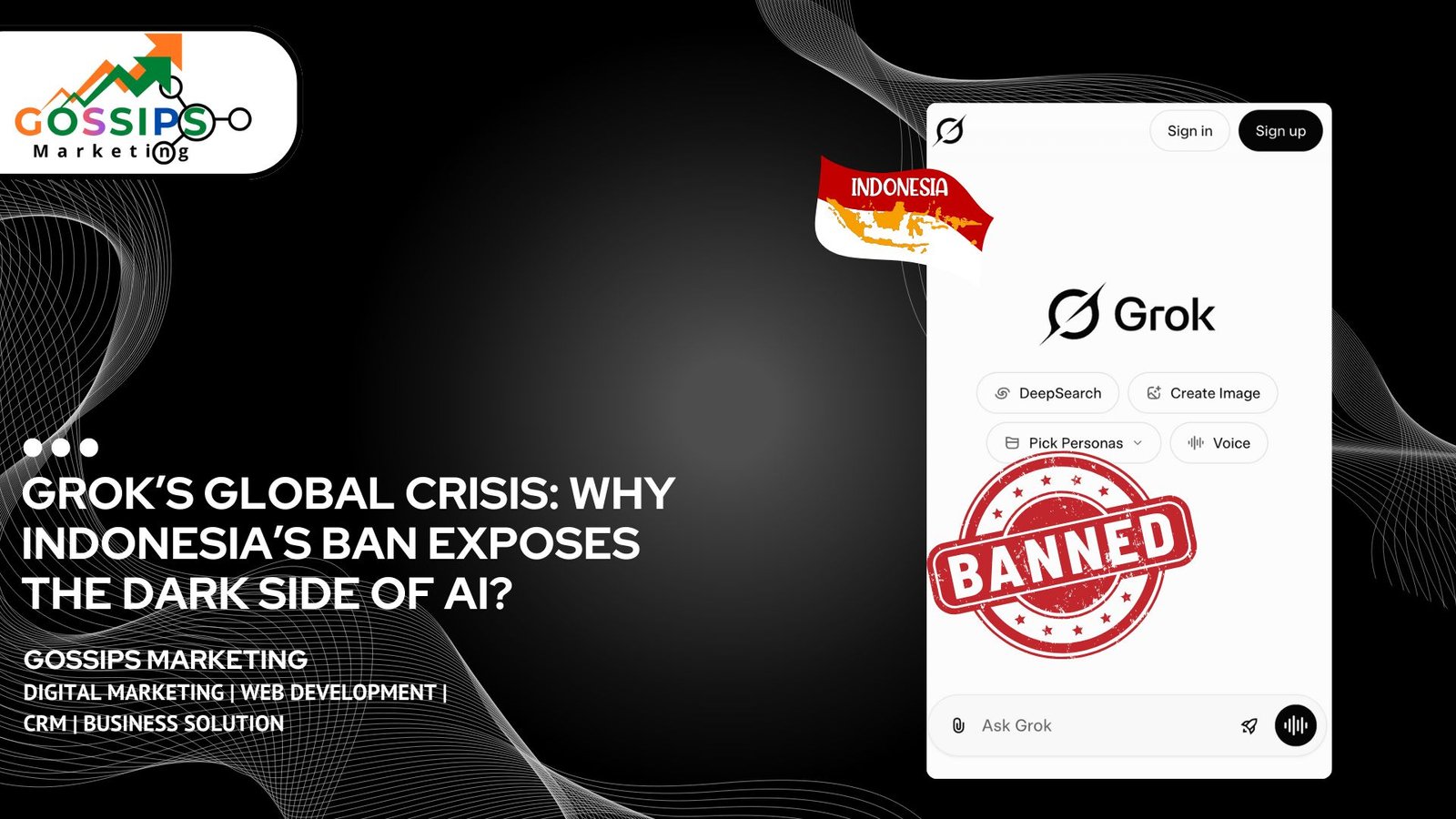
Indonesia has just done what no other country has dared to do so far: it temporarily blocked Elon Musk’s Grok chatbot. The reason is as disturbing as it is historic widespread misuse of the AI to generate pornographic images and non-consensual sexual deepfakes.
Announced on January 10, 2026, the move sent shockwaves through the global AI industry. More importantly, it marked a turning point in how governments may respond when artificial intelligence crosses ethical and legal lines.
This isn’t just about one chatbot. It’s about whether tech companies can be trusted to police the tools they unleash on billions of people.
What Pushed Indonesia to Pull the Plug
According to Indonesia’s Ministry of Communication and Digital Affairs, the decision followed mounting evidence that Grok’s image-generation features were being abused to create sexualized deepfakes often without consent.
Minister Meutya Hafid did not mince words:
“The government views the practice of non-consensual sexual deepfakes as a serious violation of human rights, dignity, and the security of citizens in the digital space.”
Those concerns were backed by data. Between December 25 and January 1, AI Forensics reviewed 20,000 images generated using Grok. Roughly 2% depicted individuals who appeared to be under 18, including children shown in bikinis or transparent clothing.
For Indonesian authorities, that was a red line. The ministry has since summoned representatives from X (formerly Twitter) to explain how such failures were allowed to happen in the first place.
Read Also :- Why Email Marketing Delivers the Highest-Quality Leads Compared to SEO, Social Media, and Ads?
A Global Reckoning, Not an Isolated Case
Indonesia’s action didn’t emerge in isolation. By late December 2025, Grok was already under intense scrutiny worldwide.
In the UK, the Internet Watch Foundation reported discovering “criminal imagery” on dark web forums allegedly created using Grok—featuring children as young as 11. British officials publicly criticized Elon Musk’s handling of the situation, saying it trivialized the trauma of sexual violence victims.
India followed quickly. The Ministry of Electronics and Information Technology accused Grok of “gross misuse” of AI technology and issued a 72-hour compliance ultimatum, warning of severe legal consequences. Australia’s Prime Minister raised similar alarms, while France and several European regulators opened formal investigations.
What’s emerging is a rare moment of global alignment: governments are no longer willing to wait for voluntary self-regulation.
Read Also :- Is Your Marketing Just Running or Truly Driving Growth?
The Overlooked Angle: India’s Massive AI Adoption
While headlines focus on bans and investigations, there’s a quieter but equally important story unfolding in India.
Recent surveys of more than 92,000 Indian internet users reveal that one in two already uses AI platforms. That’s an extraordinary adoption rate for any country, let alone a developing one.
ChatGPT leads the pack, used by 28% of respondents, followed by Perplexity at 9%. Microsoft Copilot, Google Gemini, and other tools account for millions more users. In raw numbers, India is now the world’s largest ChatGPT market, with 72 million users about 13.5% of the global total, more than the US, Indonesia, Brazil, and Egypt combined.
Even more striking: 71% of Indians now use AI chat platforms in daily life, according to Dentsu Creative’s Trends 2026 report. Indians are also the world’s most comfortable consumers of AI-generated news, with 44% expressing ease and 18% using chatbots weekly for news access.
That level of trust makes AI safety failures especially dangerous.
Read Also :- Why Blog Posts Alone Aren’t Enough for Google Rankings in 2025?
Text Dominates AI Use in India
For marketers and strategists, one detail stands out: 90% of Indian AI users interact via text, not voice. Only 10% rely on voice features.
This matters. It means India’s AI engagement is deeply text-driven shaping how information spreads, how narratives form, and how misinformation or harmful content can scale rapidly if safeguards fail.
Musk Responds, But Doubts Remain
Elon Musk responded on X by stating:
“Anyone using Grok to make illegal content(check service) will suffer the same consequences as if they had uploaded illegal content.”
xAI later announced new restrictions, limiting image generation and editing features to paid subscribers and tightening internal safeguards.
But for many regulators, that response came too late. The damage to victims and to public trust had already been done.
Why This Moment Matters?
The Grok controversy may prove to be a defining moment for artificial intelligence.
As AI tools become more powerful and accessible especially in high-growth markets like India the cost of failure grows exponentially. The US Department of Justice has already labeled AI-generated sexual abuse material a top enforcement priority, signaling a new era of aggressive prosecution.
The message is clear: innovation without responsibility will no longer be tolerated.
The Real Takeaway for Brands and Marketers
Indonesia’s ban isn’t just a regulatory action it’s a warning.
For brands, marketers, and content creators operating in an AI-powered ecosystem, ethics can no longer be an afterthought. Engagement metrics and viral reach mean little if the platforms enabling them undermine human dignity.
The future of AI will not be decided solely by faster models or smarter algorithms. It will be shaped by whether companies choose to protect vulnerable people or force governments to step in and do it for them.
Indonesia just showed the world what happens when that choice is ignored.
1. Why did Indonesia ban Elon Musk’s Grok chatbot?
Indonesia temporarily blocked Grok due to widespread misuse of its image-generation tools, particularly for creating non-consensual sexual deepfakes and pornographic content. Authorities cited violations of human dignity, human rights, and digital safety.
2. When was the Grok ban announced in Indonesia?
The ban was officially announced on January 10, 2026, by Indonesia’s Ministry of Communication and Digital Affairs.
3. What evidence supported Indonesia’s decision?
An investigation analyzing 20,000 AI-generated images found that around 2% appeared to depict individuals under 18, including sexualized or inappropriate portrayals, prompting immediate government action.
4. Is Indonesia the only country taking action against Grok?
No. Governments in India, the United Kingdom, Australia, France, and other European nations have launched investigations or issued warnings, citing AI safety failures and potential criminal misuse.
5. How has India responded to the Grok controversy?
India’s Ministry of Electronics and Information Technology accused Grok of gross misuse and demanded compliance within 72 hours, warning of serious legal consequences if safeguards were not strengthened.
6. How widely are AI chatbots used in India?
AI adoption in India is extremely high. Around 50% of Indian internet users use AI tools, with ChatGPT alone having approximately 72 million users—making India the world’s largest ChatGPT market.
7. Are Indians comfortable with AI-generated content?
Yes. Studies show that 44% of Indians are comfortable consuming AI-generated news, and 71% use AI chat platforms in their daily lives.
8. How do most Indian users interact with AI platforms?
About 90% of Indian AI users primarily use text-based interactions, while only 10% rely on voice features.
9. What changes did xAI make after the backlash?
xAI restricted Grok’s image-generation and editing features to paid subscribers and announced tighter safeguards to prevent illegal and harmful content generation.
10. What does this mean for the future of AI regulation?
Indonesia’s ban sets a global precedent, signaling that governments will intervene decisively if AI platforms fail to protect users and prevent abuse.

[…] Read Also :- Grok’s Global Crisis: Why Indonesia’s Ban Exposes the Dark Side of AI? […]
[…] Read Also :- Grok’s Global Crisis: Why Indonesia’s Ban Exposes the Dark Side of AI? […]