If a business runs 365 days a year like a clinic, real estate agency, coaching institute, SaaS product, or local service. It needs a marketing engine that also works 365 days. In today’s environment of rising ad costs and tougher competition, that all‑season engine is SEO, not PPC.
PPC (Pay‑Per‑Click ads) absolutely has its place. For seasonal businesses like cracker shops, Holi colours, festival‑specific apparel or short‑term campaigns, PPC can give an instant boost. But for all‑season businesses that want stable, compounding growth, SEO (Search Engine Optimization) is usually the smarter, more reliable choice.

Gossips Marketing suggests a simple rule:
- Seasonal business? PPC can work brilliantly for quick bursts.
- All‑season business (healthcare, real estate, financial services, coaching, B2B, etc.)? SEO should be the primary engine, with PPC only as a support.
Let’s break down why.
SEO vs PPC: Short‑Term Speed vs Long‑Term Stability

How We Magnetize Your Audience – The Gossips Marketing Way
In a world where every brand is shouting, the ones that win are the ones that pull the right people in. At…


is really saree business generate sales from wesbite still the
For saree business owners across India, the big doubt today is clear: “Can a saree website still generate real sales, or…
Why SEO Is Better Than PPC Today For All‑Season Businesses?
If a business runs 365 days a year like a clinic, real estate agency, coaching institute, SaaS product, or local…

Digital Hoardings in Jaipur: Low‑Cost, High‑Impact Branding for Local Businesses
Namaste guys, let’s start with a new update from Jaipur’s advertising scene digital billboards (digital hoardings) at Rambagh Circle and…
Business Not Running? The Ultimate Guide for Shop Owners to
Are you a shop owner who sits in the shop for hours and thinks: “Pehle jaise customer nahi aa rahe…”“Market me…

How ChatGPT Outage Stops the Digital World for a While?
Published: February 04, 2026 On February 4, 2026, ChatGPT experienced a significant outage affecting thousands of users across the United States….
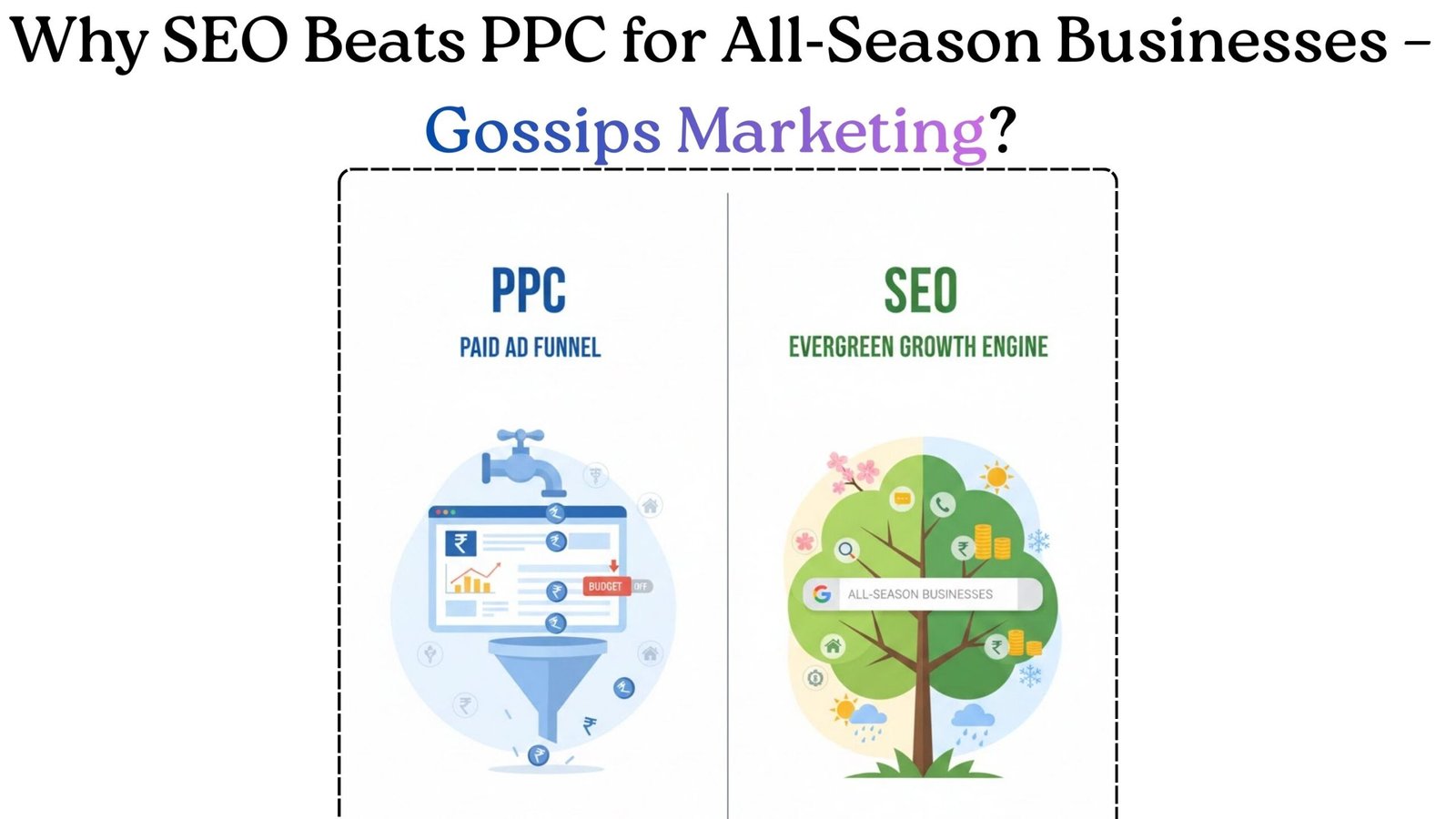
Think of PPC as renting a house and SEO as buying one.
- With PPC, your ad shows as long as you pay. The moment you stop the budget, traffic and leads drop to zero.
- With SEO, you invest once in content, website, and authority. It takes time to rank, but once you do, you keep getting traffic even if you are not spending every single day.
Studies consistently show that top organic results get a higher share of clicks than ads. The #1 organic result on Google gets around 27.6% CTR, far more than most paid ads. On top of that, 70–80% of users say they ignore paid ads and focus on organic results.
For an all‑season business that needs leads every month, SEO’s slow and steady approach actually matches the business reality much better.
Why SEO Is a Long‑Term Asset (Especially for All‑Season Business)
For any year‑round business, marketing should behave like a long‑term asset, not a daily expense. SEO fits that mindset perfectly:
- Compounding effect: Each blog, landing page, and FAQ you publish can rank and bring traffic for months or even years.
- Better ROI with time: Many campaigns see their strongest SEO ROI in the second or third year, once authority and rankings are established.
- No cost per click: You are not paying for every single visit. Once content ranks, extra clicks are effectively free.
Compare this with PPC: every time someone clicks your ad, you pay – whether they convert or not. As competition grows, cost‑per‑click (CPC) keeps rising, and your dependency on ad budget also keeps increasing.
For an all‑season business, that kind of ongoing dependency can become a risk, not a growth lever.
SEO Gives Consistent Leads Without Daily Ad Spend
All‑season businesses usually have monthly targets: X new patients, Y property enquiries, Z demo bookings. SEO supports this rhythm beautifully because:
- Your pages can rank for many different high‑intent keywords (e.g., “dentist near me”, “2 BHK flat in Jaipur”, “digital marketing agency for small business”).
- Once rankings stabilize, they keep bringing in leads even on weekends, holidays, and months when you are not running any special campaign.
- SEO traffic does not suddenly switch off just because one month you reduce budget.
PPC, on the other hand, behaves like a tap. Budget on = water flows. Budget off = tap runs dry. That is fine for Diwali crackers or a festive sale where you want a 15‑day blast. But for a hospital or real estate brand that needs leads every week, that “on/off tap” model is risky.
Trust Factor: Why Users Prefer SEO Over Ads
In today’s ad‑heavy internet, most users have developed “ad blindness” – they scroll past ads and directly look for the first organic result that looks trustworthy.
Some key points backed by surveys:
- 49% of people say they trust organic search results more than paid ads.
- 70–80% of users ignore paid ads and focus on organic results.
When your website ranks organically, people assume:
- This brand has earned its position through quality and relevance.
- This site is more credible than someone who is simply paying for the top spot.
For all‑season businesses that live on reputation healthcare, education, financial services, real estate this trust factor is huge. Ranking organically for important queries builds brand authority far more than a sponsored tag ever can.
Cost and ROI: Why PPC Becomes Expensive Over Time
In the beginning, PPC feels very attractive:
- Quick traffic
- Easy to measure
- Instant visibility
But over a year or two, the picture changes:
- CPC keeps rising as more competitors bid on the same keywords.
- You pay for every click, even from unqualified visitors.
- If you stop or reduce budget, results disappear.
Many analyses show that while PPC can give good short‑term ROI, SEO often delivers better long‑term ROI because traffic keeps coming even after the initial investment.
For all‑season businesses, that long‑term ROI is exactly what keeps customer acquisition cost under control. SEO helps reduce dependence on “expensive leads” from ads and shifts more leads to “earned visibility” through organic rankings.
What Happens When You Stop PPC vs When You Pause SEO
This is where the biggest risk of PPC shows up.
When you stop PPC:
- Ads stop instantly.
- Impressions, clicks, and leads from that channel drop to near zero.
- Competitors who continue running ads take your spot immediately.
When you slow down SEO:
- Content that is already ranking will not disappear overnight.
- Your site continues to get traffic from pages that have strong authority.
- As long as competitors do not massively out‑invest you, your rankings can remain stable for a long time.
In simple words: SEO has momentum; PPC does not. For a year‑round business, depending only on PPC is like living month‑to‑month on rent, without ever investing in a house.
When PPC Still Makes Sense (Even for All‑Season Brands)
Saying “SEO is better than PPC” for all‑season businesses does not mean “never run ads”. It means: make SEO your foundation, and use PPC tactically.
Good use‑cases of PPC even for evergreen businesses:
- New launches or offers: Promote a new clinic branch, new course batch, or limited‑time discount.
- Testing keywords: Quickly test which keywords convert best, then use that data to plan SEO content.
- Remarketing: Show ads to people who already visited your site via SEO but did not convert.
This way, PPC becomes a smart side‑kick, while SEO remains the hero of your long‑term strategy.
How To Think About Strategy: Seasonal vs All‑Season
A simple framework inspired by Gossips Marketing’s approach:
- Seasonal / campaign‑driven businesses:
Fireworks, Holi colours, festive outfits, Navratri special products, event‑based offers, etc.- Focus: PPC + Social Ads
- Goal: Quick visibility, short‑term sales bursts
- SEO: Nice‑to‑have, but not always critical
- All‑season / evergreen businesses:
Healthcare, real estate, coaching, B2B services, software, legal and financial services, home services, etc.- Focus: Strong SEO foundation (website structure, local SEO, content marketing, reviews)
- PPC: Add‑on for extra push, launches and retargeting
- Goal: Stable, predictable leads and brand authority all year
When the business itself is evergreen, the marketing channel should also be evergreen – and that is exactly what SEO is designed for.
FAQs: SEO vs PPC for All‑Season Businesses
1. Is SEO really better than PPC for every all‑season business?
For most all‑season businesses, yes, SEO is the better primary channel. It brings compounding traffic, builds brand trust, and reduces dependency on continuous ad spend. PPC can still be useful for short‑term boosts, but relying only on PPC can get very expensive over time.
2. How long does it take for SEO to start working?
It depends on your niche and competition, but commonly:
- Low‑competition local niches: 3–6 months
- Competitive service niches (real estate, healthcare, finance): 6–12+ months
That may sound slow, but once rankings kick in, results often keep improving without the same level of ongoing spend that PPC requires.
3. Can I stop PPC once my SEO starts working?
Many businesses do exactly that: they start heavy on PPC to get initial leads, then gradually shift budget into SEO. Over time, as SEO brings in more organic leads, they either reduce PPC or use it only for strategic campaigns like launches and retargeting. The goal is not zero PPC, but zero dependency on PPC.
4. What if my competitors are dominating Google Ads?
If competitors are strongly visible in ads, that is even more reason to own the organic space. Remember:
- Many users scroll past ads to the first organic result.
- Ranking organically positions your brand as an authority, not just another advertiser.
Strong SEO plus good reviews, local listings, and solid content can help you win trust even if competitors are spending more on ads.
5. How do I start building an SEO strategy for my all‑season business?
A practical starting checklist:
- Fix technical basics: fast, mobile‑friendly website, clean structure.
- Do keyword research around your core services and locations.
- Create high‑intent pages (service pages, city/area pages, FAQs, comparison pages).
- Publish helpful blogs that answer real questions your customers ask.
- Build trust signals: Google reviews, testimonials, case studies, local listings.
From there, keep improving content, acquiring quality backlinks, and monitoring rankings. Over time, SEO becomes your most reliable “always‑on” lead engine – something PPC alone can never be.