
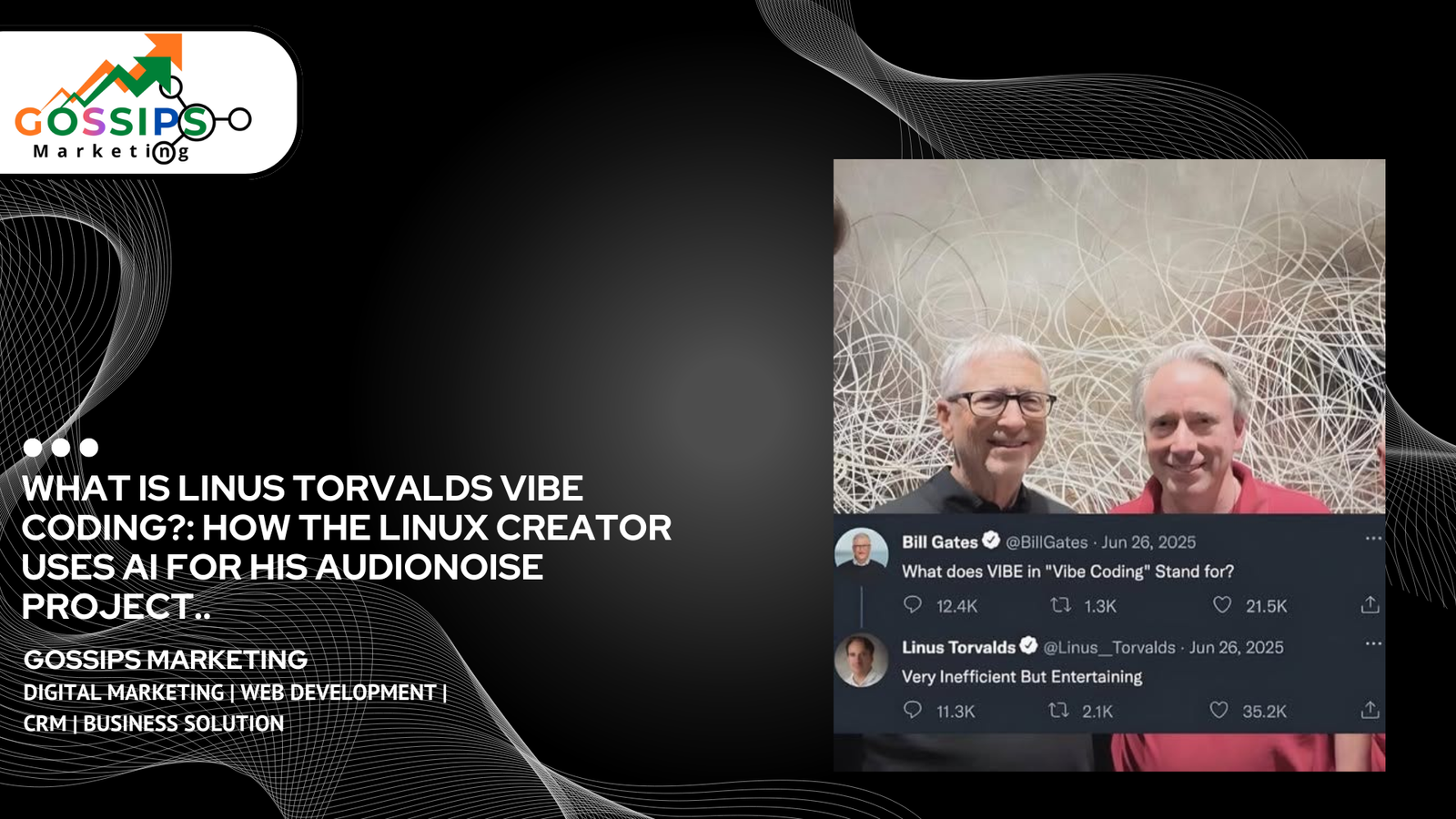
The idea that Linus Torvalds the famously blunt creator of Linux would openly use AI to help write code once sounded unlikely, if not impossible. For decades, Torvalds has been a symbol of disciplined engineering, deep systems knowledge, and skepticism toward shortcuts that compromise code quality.
Yet in 2026, something interesting happened.
Torvalds published a small hobby project called AudioNoise, and buried inside its README was a casual admission that sent ripples through the developer community: he used an AI coding tool, Google Antigravity, to generate part of the project using a workflow now known as vibe coding.
This wasn’t a publicity stunt. It wasn’t a pivot away from traditional programming. And it certainly wasn’t AI writing the Linux kernel.
Instead, it was something far more important: a clear, pragmatic signal that even the most traditional programmers are selectively embracing AI coding—when it makes sense.
This article breaks down the full story behind AudioNoise, how Torvalds used AI, what vibe coding actually means, why this matters for Linux and open source, and where AI-assisted development is heading next.
Read Also :- Grok’s Global Crisis: Why Indonesia’s Ban Exposes the Dark Side of AI?
AudioNoise: A “Toy” Project That Attracted Serious Attention
AudioNoise is a small, open-source project hosted on GitHub where Linus Torvalds experiments with digital audio effects. At first glance, it looks unremarkable no grand roadmap, no enterprise ambitions, no claims of production grade DSP performance.
But because of who built it, every detail matters.
What AudioNoise Does
AudioNoise explores simple digital signal processing (DSP) concepts, including:
- Delays and echoes
- Basic filters (such as simple IIR filters)
- Pedal-style effects inspired by guitar hardware
- Random audio “noise” experiments for learning and fun
Torvalds has repeatedly emphasized that this is not a professional audio toolkit. It is not meant to compete with DAWs, plugins, or serious DSP frameworks. Instead, it’s a learning playground, much like his early hardware guitar pedal experiments—only this time in software.
Key Facts About AudioNoise
- License: GPLv2, consistent with Torvalds’ long-standing commitment to copyleft open source
- Core language: C
- Purpose: Personal experimentation and learning
- Scope: Intentionally small and non-critical
Despite its modest goals, AudioNoise quickly gained traction. Developers weren’t just curious about the audio effects—they were curious about how Torvalds was building it.
How Linus Torvalds Used AI Coding in AudioNoise?
Torvalds’ approach to AudioNoise is split cleanly into two worlds, and that split is the most important lesson of the project.
1. Core Audio Logic: Hand-Written in C
All critical DSP logic is written manually in C. This includes:
- Audio processing loops
- Filters and delay logic
- Performance-sensitive code
This is where correctness, determinism, and performance matter most and Torvalds did exactly what you’d expect: he wrote it himself.
2. Python Visualiser: AI-Assisted Vibe Coding
The surprise comes with the Python-based audio visualiser.
Torvalds admits openly that Python is not his comfort zone. His previous workflow was what many developers recognize instantly:
“Google things, copy examples, tweak them until they work.”
This time, he did something different.
He used Google Antigravity, an AI-powered coding environment, to generate the Python visualisation code from natural-language descriptions. In his words, he decided to “cut out the middle-man” himself and let the AI handle the Python scripting directly.
This is vibe coding in its purest form:
- Describe what you want
- Let the AI write the unfamiliar code
- Review and integrate the result
No ego. No dogma. Just efficiency.
What Is Vibe Coding? From Buzzword to Real Workflow?
“Vibe coding” may sound like marketing slang, but it describes a real and growing development workflow.
The Core Idea of Vibe Coding
In vibe coding:
- You express intent, not syntax
- The AI generates code based on natural language prompts
- You guide, review, test, and refine the output
The developer becomes less of a typist and more of an architect and reviewer.
Where the Term Comes From
The phrase gained popularity after AI researchers like Andrej Karpathy described coding sessions where developers “fully give in to the vibes” letting large language models handle most of the implementation while humans steer direction and correctness.
This idea has moved rapidly from theory to practice.
Enterprise Adoption Is Already Happening
Reports that Apple is working with Anthropic to build an AI-powered vibe-coding platform for Xcode underscore how mainstream this approach is becoming. That internal system uses Claude Sonnet to write, edit, and test code for Apple developers—embedding AI directly into professional workflows.
Torvalds using Google Antigravity for a Python visualiser fits squarely into this trend, just without the corporate press release.
Why Linus Torvalds’ AI Usage Actually Matters
Torvalds has never been anti-automation. What he has always been is anti-bad code.
Historically, his criticisms of AI-generated code focus on three issues:
- Maintainability – Code that “works” but is hard to understand later
- Correctness – Subtle bugs are unacceptable in infrastructure software
- Standards – Linux has strict expectations around clarity and review
That’s why AudioNoise is such a telling example.
His AI Usage Is Carefully Scoped
- The project is non-critical
- AI is used only for supporting code, not core logic
- Human review remains mandatory
This is not AI replacing expertise. It’s AI augmenting it.
A Message to the Linux and Open-Source Community
Torvalds’ approach sends a clear signal:
- AI is not ready to write kernels or safety-critical systems autonomously
- But AI is extremely useful for:
- Visualisation
- Glue code
- Prototypes
- Learning outside your core domain
That balance is likely to define how AI coding evolves in serious engineering circles.
AudioNoise as a Glimpse Into the Future Developer Workflow
The importance of AudioNoise isn’t the audio effects—it’s what the project reveals about how development is changing.
1. Learning Through Play Still Matters
Torvalds chose audio effects because they’re fun. DSP lets him explore math, signal behavior, and experimentation without enterprise pressure. AI tools make that exploration faster and less frustrating.
2. AI Removes Friction, Not Responsibility
AI didn’t design the DSP algorithms. It didn’t decide architecture. It simply removed the friction of working in a language Torvalds didn’t want to master deeply.
3. The Linux Mindset Still Applies
The same principles that shaped Linux apply here:
- Humans own responsibility
- Tools exist to serve developers, not replace judgment
- Quality is non-negotiable
What This Means for Developers in 2026 and Beyond
AudioNoise offers a blueprint most developers can safely follow:
- Hand-craft performance-critical and correctness-critical code
- Use vibe coding for UI, visualisation, scripts, and prototypes
- Review everything AI generates
- Treat AI like a junior assistant, not an oracle
This isn’t a retreat from craftsmanship. It’s an evolution of it.
Frequently Asked Questions (FAQ)
Q1. What is Linus Torvalds’ AudioNoise project?
AudioNoise is a small, open-source GitHub project where Linus Torvalds experiments with digital audio effects such as delays and filters. Written primarily in C and licensed under GPLv2, it is explicitly a hobby project meant for learning digital signal processing—not a professional audio framework.
Q2. Did Linus Torvalds use AI to write Linux kernel code?
No. Linus Torvalds has not used AI to write Linux kernel code. His AI usage was limited to generating a Python-based audio visualiser for the AudioNoise hobby project. All core logic, including DSP code, was written manually.
Q3. What is Google Antigravity?
In this context, Google Antigravity refers to an experimental AI-powered coding environment. Torvalds used it to generate Python code from natural-language prompts, enabling a vibe-coding workflow for the AudioNoise visualiser.
Q4. What does “vibe coding” actually mean?
Vibe coding is an AI-assisted development style where programmers describe desired behavior in plain language and let an AI generate code. The developer then reviews, refines, and integrates the output, focusing more on intent and architecture than syntax.
Q5. Is vibe coding safe for production software?
Vibe coding is currently best suited for:
- Prototypes
- Internal tools
- Visualisation and glue code
- Learning projects
For large, long-lived, or safety-critical systems, heavy reliance on AI-generated code without deep human review introduces risks in maintainability and correctness.
Q6. How can Gossips Marketing help you understand AI coding better?
Gossips Marketing helps translate complex technical trends—like Linus Torvalds’ use of AI in AudioNoise—into clear, actionable insights. Through blogs, explainers, and strategy-driven content, it bridges the gap between developers, founders, and non-technical stakeholders, making AI coding trends easier to understand and apply.
Final Thoughts
Linus Torvalds didn’t “embrace AI” in the way headlines often suggest. He did something far more valuable: he used it responsibly.
AudioNoise shows what AI coding looks like when guided by experience, discipline, and humility. As vibe coding moves from novelty to norm, the developers who thrive won’t be the ones who surrender control—but the ones who know exactly where to let go, and where to hold on.