

Your real estate business lives or dies by one critical factor: how effectively you convert online visitors into actual property buyers. In this digital era, you having a stunning social media presence is simply not enough. You need a professional website that acts as your virtual office, your portfolio, and your lead-generating machine which is rolled into one powerful tool.
Let’s be honest free website builders might seem tempting when you’re starting out. You see the zero price tag and think, “Why not?” But here’s the reality: free platforms are like trying to run a premium real estate business from a cardboard booth at a trade show. They look cheap, they feel unprofessional, and worst of all, they don’t deliver results. When you invest ₹15,000 to ₹50,000 in a properly built website, you’re not just buying a web page you’re investing in business credibility, customer trust, and a system that works 24/7 to bring qualified leads to your door.
Why Your Real Estate Business Absolutely Needs a Website?
Let’s Imagine this scenario You post a stunning property listing on Facebook with a beautiful photo and written caption. A potential buyer sees it, feels interested, and wants to learn more. But here’s where it falls apart. Facebook gives them a little bit of information, maybe a few photos, and that’s it. They can’t explore your other properties, read about your expertise, or find testimonials from satisfied clients. They certainly can’t fill out a contact form or schedule a property viewing directly from the platform.
Now compare that with a professional website.
A dedicated website transforms how you present your business to the world. It’s not just another page on social media it’s your complete business ecosystem. Your website can host:
Portfolio of all your properties with high-resolution images, virtual tours, and detailed descriptions that social media platforms can never accommodate. Your prospects can browse at their own pace, compare properties, and engage with your listings meaningfully.
Blog section filled with industry expertise where you publish research on market trends, neighborhood guides, and real estate insights that position you as a trusted authority in your market. This content doesn’t just sit there it attracts organic traffic from Google month after month, bringing qualified prospects directly to your doorstep.
Professional presentation elements that build credibility with your audience. A custom-designed website with consistent branding, professional typography, and thoughtful color schemes communicates that you’re serious about your business. Most competitors in real estate are still relying on Facebook and Zillow listings. When your prospects visit your website and see a polished, professional presence, they immediately perceive you as more trustworthy and established.
Lead capture systems with strategically placed contact forms, property inquiry buttons, and call-to-action elements that turn casual browsers into actual leads. Your website works for you even when you’re sleeping capturing visitor information, scheduling inquiries, and nurturing relationships automatically.
The ROI of a Professional Real Estate Website
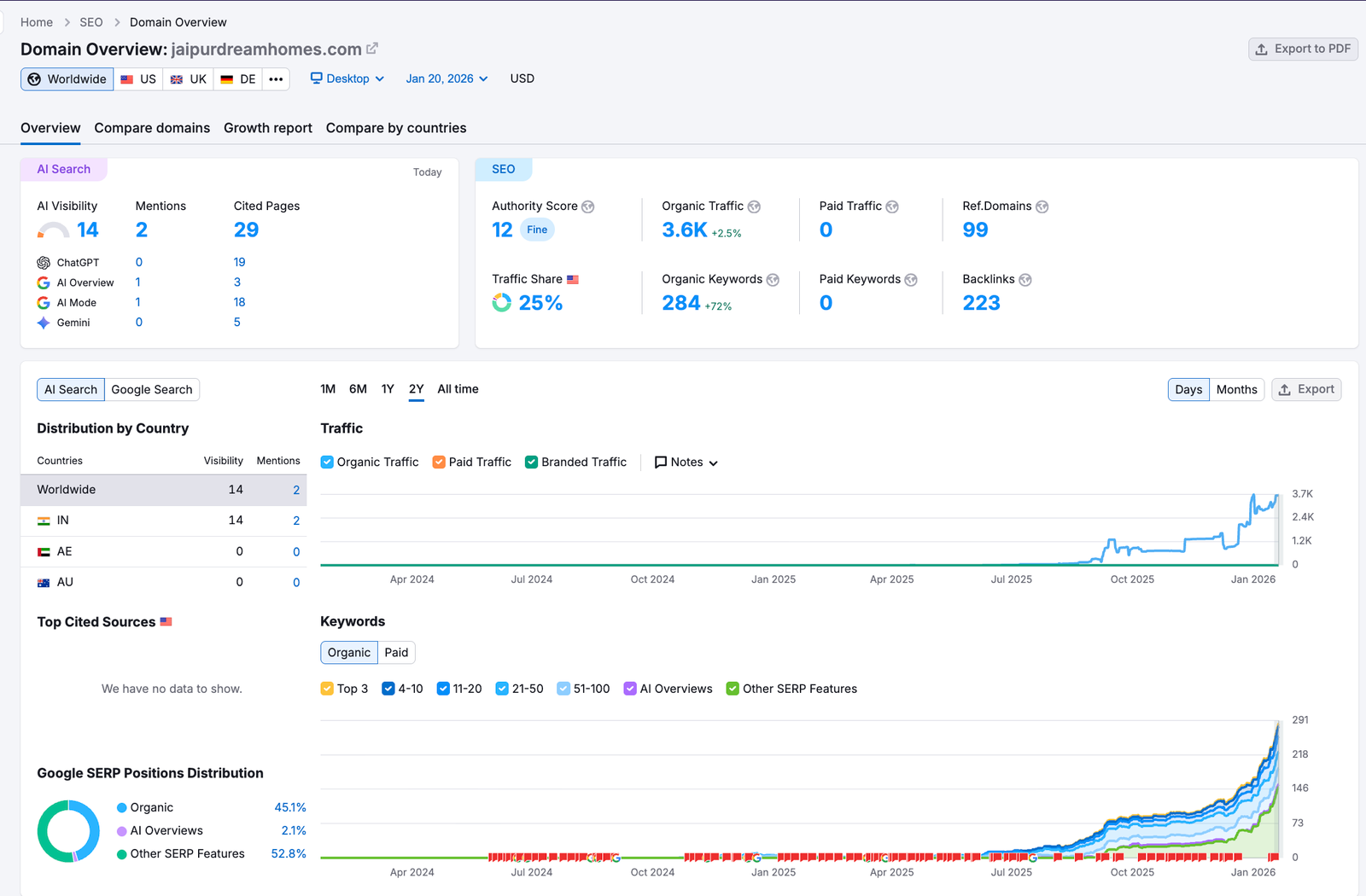
Here’s a metric that should grab your attention: businesses with websites see significantly higher conversion rates than those relying solely on social media. When someone lands on your website, they’re already interested in what you’re offering. They didn’t stumble there by accident they actively searched for real estate services or found you through an optimized Google search result.
Consider this real-world example from our work with clients: Jaipur Dream Homes is a real estate business that invested in a comprehensive website built on React and Node.js frameworks. Since launching their optimized site, they’re generating 15-20 organic leads per day. These aren’t random clicks these are qualified prospects actively searching for properties in their area. Combined with ongoing SEO optimization for real estate, this client is seeing consistent, predictable lead flow that translates directly into closed deals.
That’s the difference between a website and no website. That’s the difference between guessing at your marketing and having a system that delivers measurable results.
Essential Elements to Include in Your Real Estate Website
Building a real estate website isn’t about throwing random pages together. There’s a strategic structure that works best:
Home Page: This is your first impression. Your homepage should communicate your value proposition instantly what makes your real estate business different from the dozen competitors in your market. Feature your best properties, include client testimonials, and make it immediately clear what action you want visitors to take next.
Blog/Resources Page: This is where SEO magic happens. Regular blog posts about neighborhood guides, real estate market trends, investment tips, and buying/selling advice attract organic traffic from Google. Each blog post is another page that can rank in search results, bringing visitors to your site. Consistency is key aim for 2-3 quality blog posts weekly to establish authority in your market.
Home Loan EMI Calculator
Property Listings Page: A searchable database of your current properties with advanced filters for price range, property type, location, and amenities. Make sure each listing has professional photos, detailed descriptions, and a clear call-to-action for inquiries.
About Page: Tell your story. Share your background, your expertise, your team, and why you’re passionate about real estate. People do business with people they trust, and your about page builds that trust.
Contact Page: Multiple ways for prospects to reach you contact forms, phone numbers, email addresses, and location information. Make it impossible for an interested prospect to not be able to contact you.
Privacy Policy and Terms & Conditions: These aren’t just legal boxes to check. They signal professionalism and protect both you and your clients. They’re essential for credibility.
Choosing Your Website Building Platform
You have several options for building your real estate website, each with different trade-offs:
Custom Development (React, Node.js, Next.js): If you want a website that’s completely unique, scalable, and powerful, custom development is the way to go. Platforms like React and Node.js give you unlimited flexibility. The tradeoff? Higher initial investment (₹40,000-₹1,50,000+) and longer development timelines. But you own your website completely, and it’s built specifically for your business needs. This is the premium option that delivers premium results.
CMS-Based Frameworks (WordPress with Elementor): WordPress is the most popular website platform globally, and for good reason. It’s cost-effective (₹15,000-₹40,000 for setup), easy to manage, and there’s an enormous ecosystem of plugins and themes designed for real estate. You don’t need to know code to update your website. WordPress is ideal if you want to balance cost, control, and ease of use.
Website Builders (Wix, Webflow, Placester): Platforms like Wix and Webflow offer drag-and-drop simplicity without any coding required. They handle hosting, security, and technical maintenance. They start around ₹5,000-₹15,000 for setup. The downside? Limited customization and you don’t truly own your website you’re renting it. If the platform changes their terms or pricing, you’re at their mercy.
Specialized Real Estate Platforms (Sierra Interactive, Carrot): These platforms are built specifically for real estate professionals with features like IDX integration, CRM tools, and lead management built-in. They’re pricier (₹1,000-₹3,000 monthly) but they solve real estate-specific problems out of the box.
Design Elements That Actually Sell Properties
Your website design isn’t just about looking pretty. It’s about psychology converting visitors into leads and leads into buyers.
Color Palette: Real estate websites typically use professional, calming colors. Whites and light grays create an open, clean feeling. Accent colors like navy blue or warm earth tones convey trust and stability. Avoid bright neons or jarring contrasts that distract from your properties.
Typography: Use clean, modern fonts that are easy to read on both desktop and mobile. Pair a professional serif font for headings with a readable sans-serif for body text. Limit yourself to 2-3 font families maximum to maintain cohesion.
Professional Images: This cannot be overstated. Every property needs multiple high-resolution photos. Invest in professional photography or at minimum, use a good camera and editing software. Blurry, poorly lit photos will drive prospects away instantly. Consider including virtual tours or 360-degree images for premium properties.
Background Imagery: Use high-quality background images that complement your brand. For a real estate website, think architectural elements, beautiful neighborhoods, and lifestyle shots that appeal to your target audience. Avoid stock photos that look obviously fake or generic.
Navigation: Make it simple for visitors to find what they’re looking for. Intuitive navigation menus, breadcrumbs showing where they are on your site, and prominent search functionality keep visitors engaged rather than frustrated.
How SEO Transforms Your Real Estate Business
You can have the most beautiful website in the world, but if no one can find it on Google, it’s worthless. Search engine optimization isn’t optional it’s fundamental to your website’s success.
Local SEO is Your Foundation: Real estate is inherently local. Optimize your website for local search terms like “Real Estate Agent in [Your City]” or “Best Properties in [Your Neighborhood]”. Create dedicated pages for each neighborhood or area you serve. Each location page becomes another opportunity to rank in search results.
Content Marketing Drives Traffic: Every blog post you write is an opportunity to rank for keywords your prospects are searching for. Someone searching “Is Now a Good Time to Buy in Jaipur?” could land on your blog post about current market conditions. That blog post brings them to your website where they see your listings and contact information.
Technical SEO Matters: Your website needs to be fast-loading, mobile-friendly, and properly structured with heading tags and meta descriptions. Google’s algorithm considers these factors when deciding which sites to rank. A slow website might rank lower than a fast competitor even if your content is better.
Real-World SEO Results: Consider a real estate team that started with just 20 visitors daily. After implementing a comprehensive SEO strategy with regular blog posts, location pages, and technical optimization, they reached 4,000 visitors monthly within five months. That’s not a coincidence that’s the power of SEO compounding over time.
Website Maintenance and Long-Term Success
Here’s where most real estate businesses fail: they build a website and then neglect it. A website isn’t a “set it and forget it” investment. It requires ongoing maintenance to deliver results.
Content Updates: Fresh content signals to Google that your website is active and valuable. Regular blog posts, updated listings, and refreshed information keep both search engines and visitors engaged. Allocate time weekly for content updates.
SEO Management: Track your rankings for target keywords, analyze which pages drive leads, and continuously refine your strategy. Tools like Google Search Console and Google Analytics show you exactly what’s working.
Technical Maintenance: Regular backups, security updates, and performance optimization keep your website running smoothly and protect against security threats.
Hosting Quality Matters: Invest in reliable hosting with 99.99% uptime guarantees. Providers like Hostinger offer high-performance hosting with fast servers and excellent security. A slow or frequently-down website will destroy your credibility and search rankings.
When you maintain your website consistently updating content, optimizing for SEO, and keeping everything technically sound you’re saying “yes” to leads and growth. When you neglect it, you’re leaving money on the table.
Real Estate Website Pricing: What You Should Expect
Let’s get specific about costs because this is where many real estate businesses make poor decisions.
DIY Website Builders: ₹5,000-₹15,000 initial investment + ₹500-₹2,000 monthly for premium features. Good for testing ideas, but limited for serious business.
WordPress with Custom Theme: ₹15,000-₹40,000 initial investment + ₹2,000-₹5,000 for annual maintenance. This is the sweet spot for most real estate businesses.
Custom Development: ₹40,000-₹1,50,000+ initial investment + ₹5,000-₹15,000 annual maintenance. Premium option with unlimited customization.
Specialized Real Estate Platforms: ₹20,000-₹40,000 initial + ₹1,000-₹3,000 monthly recurring. Built specifically for real estate but ongoing monthly costs add up.
Important Reality Check: Some developers will offer “free websites” or suspiciously cheap options. Remember you get what you pay for. A truly free website usually means you have limited control, poor design, and zero support. A website built on a shoestring budget often looks it, and your prospects will judge your business accordingly.
The right question isn’t “What’s the cheapest website?” It’s “What website will generate enough leads to pay for itself and then some?” A website costing ₹30,000 that generates 2-3 qualified leads monthly will pay for itself in a single sale. That’s an excellent investment.
Case Study: Jaipur Dream Homes
Let’s look at a real example of what a properly built real estate website can achieve. Jaipur Dream Homes invested in a comprehensive website built on modern technologies (React and Node.js). The site features:
- Professional property listings with high-quality images and detailed descriptions
- Neighborhood guides and market insights published regularly through blog posts
- Lead capture forms and inquiry systems
- Mobile-responsive design that works perfectly on all devices
- Technical SEO optimization for local Jaipur search terms
Since implementing this website with ongoing SEO management, Jaipur Dream Homes generates 15-20 organic leads per day. These are prospects who found them through Google search and are actively interested in their properties. The organic lead generation is supplemented with day-by-day SEO optimization for real estate that keeps the site ranking for competitive keywords.
This didn’t happen overnight, but through consistent effort, professional execution, and strategic optimization, they transformed their online presence from non-existent to generating significant qualified leads.
Frequently Asked Questions About Real Estate Websites
Q: Should I use a no-code platform like Webflow or Wix, or hire a freelance web developer?
From Reddit’s r/nocode community
A: It depends on your goals. If you want a quick solution with minimal technical knowledge, no-code platforms like Wix or Webflow work well. However, if you need specific features like advanced property search, lead management, or unlimited customization, a freelance developer gives you more flexibility. Many real estate professionals start with a no-code platform to launch quickly, then upgrade to custom development as their business grows. The key is finding someone with specific experience building real estate websites ask to see 2-3 similar projects they’ve completed.
Q: How long does it actually take to build a real estate website?
From Reddit’s r/webdev
A: A basic website with 5-7 pages typically takes 2-4 weeks with a freelance developer working part-time, or 1-2 weeks with full-time attention. More complex websites with property search functionality, virtual tours, and advanced features might take 4-8 weeks. The timeline depends on how clear your requirements are, how quickly you provide feedback, and the complexity of features needed. WordPress sites tend to be faster than custom builds.
Q: Is SEO really worth the investment for real estate websites?
From Reddit’s r/realtors
A: Absolutely yes, but with important nuance. SEO is specifically valuable for attracting sellers looking for an agent, not so much for direct property buyers (who typically use Zillow or Realtor.com). The best strategy focuses on location pages, neighborhood guides, and content that establishes you as a local expert. One real estate professional with 25 years of SEO experience reports taking a real estate team from 20 visitors daily to 4,000 monthly visits within five months with 120 conversions in a single month. That ROI speaks for itself.
Q: What’s the difference between a free website and a paid website for real estate?
From Reddit’s r/webdevelopment
A: Free website builders are limited by design. You don’t actually own your website you’re renting it. If the platform changes pricing, terms, or shuts down, you lose everything. You also can’t take your content or design to another platform. Paid websites give you ownership, control, and access to premium features like custom domains, advanced customization, proper lead capture systems, and professional support. For real estate specifically, free sites lack the lead generation tools and professional appearance necessary to compete effectively.
Q: How much should I realistically expect to pay for my real estate website?
From Reddit’s r/realtors
A: For a quality, professionally built website that generates leads, budget ₹15,000-₹50,000 initial investment. WordPress builds typically cost ₹15,000-₹40,000. Custom development runs ₹40,000-₹1,50,000+. Specialized real estate platforms add ₹1,000-₹3,000 monthly. The cheapest isn’t always best a website costing ₹30,000 that generates 2-3 qualified leads monthly pays for itself from a single property sale. Focus on ROI, not just upfront cost.
Q: What’s the best website builder specifically for real estate agents?
From Quora and Reddit consensus
A: Wix remains popular for its ease of use and real estate templates. WordPress with Elementor offers flexibility and cost-effectiveness. Specialized platforms like Sierra Interactive, Real Geeks, and Carrot are built specifically for real estate with IDX integration and lead management. Webflow works well if you want custom design without coding. The “best” depends on your budget, technical comfort, and specific features needed.
Q: Can I really generate consistent leads from my website if I maintain it properly?
From Reddit’s r/realtors
A: Yes. One realtor manages a website generating 3,000+ visitors monthly and closing 4-5 deals monthly just from website leads. Another real estate team generates 15-20 organic leads daily from a properly optimized website. The key is consistent maintenance updating content, publishing blog posts regularly, maintaining technical performance, and optimizing for local search. If you maintain your website actively, you can absolutely build a consistent lead generation engine.
Q: Are free real estate websites worth considering?
From Reddit’s r/webdevelopment
A: Short answer: no. Free website builders severely limit your customization, lead capture capabilities, and professional presentation. They also come with significant restrictions you can’t fully own your data, you’re limited in integrations, and migration away from the platform is difficult. Spending even ₹10,000-₹15,000 on a proper website yields dramatically better results than free alternatives. This is one area where being cheap actually costs you money in lost leads and diminished credibility.
The Bottom Line: Your Website is Your Business
Your real estate business is only as credible as your online presence. Social media is a supplement your website is the foundation. When you invest in a professional website and maintain it consistently with fresh content and SEO optimization, you’re building an asset that works for you 24/7.
Every day you operate without a proper website, your competitors are capturing leads you should be getting. Every month you delay, your search engine rankings fall further behind. Every quarter you neglect optimization, you leave qualified prospects on the table.
Stop thinking of your website as an expense. Think of it as your best salesperson one that never gets tired, never makes mistakes, and works around the clock to bring prospects directly to your door. That’s the power of a properly built, actively maintained real estate website.
Are you ready to turn your website into your biggest lead generation asset? The time to start is today.